




















































![L-R: Managing Director, BGL Securities Limited, Arnold A. Dublin-Green; Assistant Vice President, Financial Derivatives Limited, Dr. Ifeoma Nwokolo; CEO, Centre for the Promotion of Private Enterprise [CPPE], Muda Yusuf (speaker); Chairman of the Occasion, Chief Paul Usoro; Dean, Lagos Business School, Information Systems, Prof. Olayinka David-West; Managing Director/CEO, Financial Derivatives Company, Bismarck Rewane; Group Chief Branding & Communications Officer, Dangote Industries Limited, Anthony Chiejina at Dangote Petroleum Refinery & Petrochemicals IPO Roadshow tagged “Back to where it all began” in Port Harcourt. Rivers State on Monday, October 12, 2026…](https://pmparrotng.com/wp-content/uploads/2026/10/Dangote-imagee-180x135.jpg "As Dangote Refinery’s IPO Nears Close, Small Investors Take Center Stage")






The federal government has announced an N180 billion annual zero-rated data initiative to provide five million students across Nigeria with 100 megabytes (MB) of free internet access to access approved educational websites and digital learning platforms from October 1, 2026.
The Nigerian Communications Commission (NCC) is behind the initiative, which will initially cover learners in public senior secondary schools and tertiary institutions in partnership with telecommunications operators under the auspices of the Association of Licensed Telecommunications Companies of Nigeria (ALTON) and the Federal Ministry of Education.
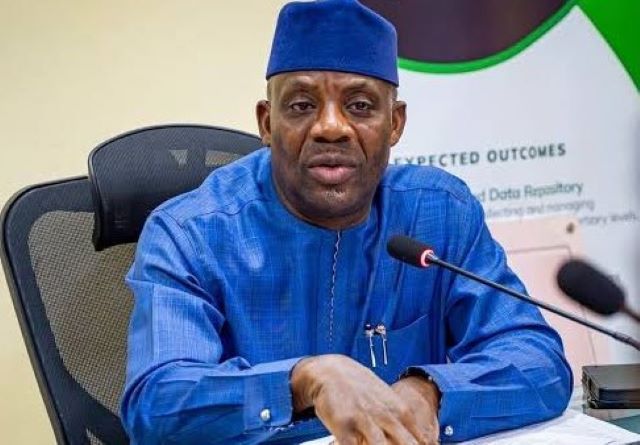
The Minister of Education, Tunji Alausa, who disclosed this on Thursday in Abuja during the official launch of the Zero-Rated Access to Education Platforms and Content initiative in Nigeria in Abuja, said, “Let me let out the secret. This will be made available to Nigerian students from October 1st, 2026.”
Alausa said that ALTON will provide 100 MB (N100) daily and N3,000 monthly for about five million students, which will amount to N15 billion monthly and N180 billion annually.
“Let me make it clear that ALTON will provide every student with 100 MB of data daily, which will amount to N3,000 monthly. If you multiply this by the 5,000,000 students, it will give you N15 billion monthly. And when you multiply N15 billion with 13 months, it will give you N180 billion. UNICEF should take note of this addition to our education budget,” the minister said.
Although the initiative has been officially launched, Alausa noted that it will become accessible by October 1 this year.
“I’ll give them the privilege of announcing the go-live. But let me let out the secret. This will be made available to Nigerian students from October 1, 2026. Today’s launch represents much more than a telecommunications initiative. It is an education intervention. It is an inclusion intervention, and most importantly, it is an investment in the future of millions of young Nigerians.
“We recognise that we cannot build a 21st-century education system using 20th-century tools. We cannot effectively manage an education system as large and complex as Nigeria without relying on data, and we cannot prepare our children for an increasing digital economy if millions of them remain excluded from digital learning opportunities,” he added.
He said the Federal Ministry of Education has embarked upon one of the most ambitious and expansive education data and digitalisation in the nation’s history through the Nigeria Education Data Initiative.
“We’re building a unified national education data architecture that connects local government areas, states, and federal institutions and provides reliable information for planning policy formulation and decision-making for the first time in the history of our nation,” he said.
While acknowledging the contribution of ALTON to the programme, he stated that under the framework, participating mobile network operators will provide a daily zero-rated data allowance of 100 MB, which beneficiaries can use on approved educational websites and platforms.
According to him, the initiative would begin with senior secondary school and tertiary institution students before being extended to other categories of learners.
“Our ambition must be that, ultimately, no Nigerian learner should be denied access to quality educational content simply because he or she cannot afford data,” he said.
The cost of internet data had become a major barrier to digital education, particularly for children from low-income households, he noted, adding that providing access to educational platforms without data charges could transform mobile phones, tablets, and computers into classrooms and libraries for students who might otherwise struggle to access digital resources.
Alausa also revealed that the government was working on measures to regulate internet access for children below the age of 16, with further details expected to be announced.
He said educational content made available to children must be “appropriate, credible, safe, and aligned with our educational objectives and our curriculum.”
The NCC Director of Policy, Competitions, and Economic Analysis, Ayuba Shuaibu, said the Federal Ministry of Education and the commission would jointly approve the educational platforms to be whitelisted under the initiative.
According to him, eligible platforms would include learning management systems, digital libraries, educational repositories, and teacher development platforms, as well as technical and vocational training platforms.
“The framework also adopts the operator’s consult model for the initial rollout of the initiative. Under this model, a daily zero-rated data allowance of 100 MB will be provided by the participating MNOs for usage on approved websites and platforms,” he said.
The scheme, Shuaibu stated, would provide zero-rated access to public secondary schools and public tertiary institutions, giving students access to selected learning resources at no cost.
The framework also requires compliance with telecommunications laws and regulations covering cybersecurity, consumer protection, child protection, and data protection. It also contains safeguards on net neutrality, fair competition, and inclusivity.
Earlier, the NCC Executive Commissioner for Stakeholder Management, Rimini Makama, said millions of students were unable to access digital learning platforms because of affordability challenges.
She said the initiative was designed to ensure that no learner was excluded from educational content because of location or household income.
“The Zero-Rated Access Initiative exists to erase that line. Its principle is simple: no learner should be shut out of educational content because of where they live or what their family earns,” Makama said.
The Minister of Communications, Innovation, and Digital Economy, Dr. Bosun Tijani, represented by the Director, National Frequency Management Council Secretariat, Adetunji Adeyemo, described the initiative as a significant step towards making digital education more affordable and accessible, particularly to learners in underserved communities.
He pledged the ministry’s continued support for programmes promoting digital inclusion, affordable connectivity, and access to knowledge.
Packaged by Dare Raji