

























































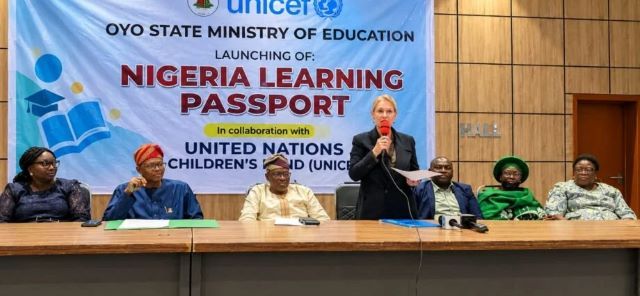
The Oyo State Government, in collaboration with the United Nations Children’s Fund (UNICEF) and several private sector stakeholders, has inaugurated the Nigeria Learning Passport (NLP), an initiative designed to enhance digital access to education throughout the state.
NLP is an online e-learning platform with mobile and offline capability that enables continuous access to quality education.
Nigeria Learning Passport is also an ‘education model’ for early childhood education, primary and secondary education, adolescent skills, and technical and vocational education.
Every user has a personalised record of their learning history, which is unique to them.
No fewer than 2.4 million children and teachers across Nigeria are already using the Nigeria Learning Passport, with Oyo State becoming the 26th state to adopt it.
Speaking at the event, Gov. Seyi Makinde described the initiative as a major step towards repositioning education to meet the demands of the 21st century.
Makinde, represented by the Commissioner for Education, Science, and Technology, Hon. Segun Olayiwola reiterated that technology is rapidly changing how people work, communicate, and acquire knowledge, emphasising that education must not be left behind in this transformation.
He said that the state government, in line with its commitment to human capital development, is embracing the NLP to strengthen digital learning and expand access to quality educational resources.
The governor stressed that learning should not stop when a child leaves the classroom, adding that the government is promoting a culture where learners can continue to learn at home and in their communities.
“Our vision is to build an inclusive, innovative, and technology-enabled education system where every child has the opportunity to learn; every teacher has the opportunity to improve; and every school is connected to resources for effective learning,” he said.
He, however, noted that the success of the platform will not be measured by the launch alone, but by how effectively schools, teachers, and learners adopt and use it.
While appreciating UNICEF for its partnership, Makinde urged teachers, learners, school administrators, SUBEB, TESCOM, and other stakeholders to take ownership of the initiative.
He also tasked them with ensuring it becomes an integral part of learning, with priority on underserved communities.
The UNICEF Chief of Lagos Field Office, Celine Lafoucriere, urged the government to deliberately prioritise children in rural and underserved communities to ensure the newly launched NLP in the state delivers lasting impact.
Lafoucriere elaborated that the platform provides access to thousands of curriculum-aligned lessons in mathematics, English, and science, which can be utilised online or offline via mobile devices. She noted that mobile operator Airtel is covering data expenses, allowing users to access content at no cost and ensuring equitable opportunities for families.
The UNICEF representative explained that the Nigeria Learning Passport was initially developed to sustain educational continuity during the extensive school closures instigated by the COVID-19 pandemic and has since evolved into a vital component for enhancing educational systems.
This initiative represents a collaborative effort involving technology supplied by Microsoft, funding from the Global Partnership for Education, infrastructure support from IHS Towers, hardware contributions from TECNO, and data services provided by Airtel. UNICEF is responsible for managing curriculum alignment, the translation into local languages, and teacher training programs.
Lafoucriere emphasised the necessity for state officials to prioritise the educational needs of children in rural and underserved communities, particularly young girls who encounter significant barriers to education. She underscored the importance of ongoing professional development for incoming educators.
Furthermore, she called for the establishment of strict mechanisms to monitor actual learning outcomes and active platform usage, rather than relying on registration statistics alone. The effectiveness of the platform should be evaluated by its capacity to enhance the educational experiences of children in remote areas.
With this launch, Oyo State becomes the 26th state in Nigeria to adopt this digital learning tool, joining a network that currently serves approximately 2.4 million children and educators nationwide.
Packaged by Lanre Olabisi