






























































The Guild of Corporate Online Publishers (GOCOP) has trained its members on the effective use of Artificial Intelligence (AI) tools to enhance the speed, quality and profitability of online publishing.
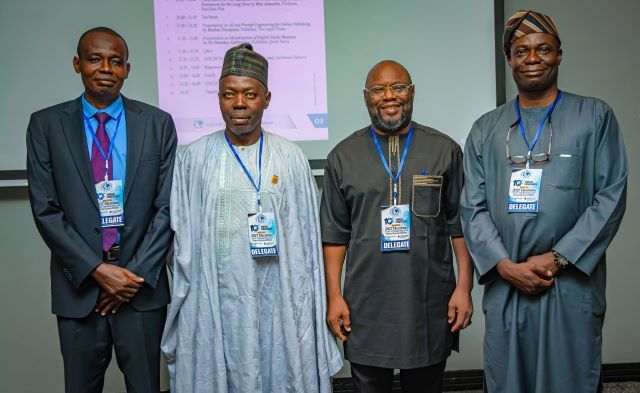
The training, titled “The AI-Powered Newsroom: AI & Prompt Engineering for Online Publishing,” was anchored by AI expert and publisher of The Lagos Times, Sulaimon Durojaiye, on the sidelines of the Guild’s 10th Annual Conference holding from October 8 to 9, 2026, at the Radisson Blu Hotel, GRA, Ikeja, Lagos.
Durojaiye explained that AI enables computers to perform tasks that ordinarily require human intelligence, noting that publishers do not need to be programmers to deploy the technology effectively. He said AI can understand language, recognise patterns, analyse information, generate content, solve problems, make predictions and assist in decision-making.
He identified three key AI concepts every publisher should understand as Generative AI, Large Language Models (LLMs) and AI-powered tools. According to him, Generative AI can create and transform text, images, audio, video and code, while LLMs are systems trained on vast amounts of information to understand and generate human language, with ChatGPT, Gemini, Claude and Copilot among the examples.
Durojaiye cautioned publishers against treating AI as a replacement for search engines or human journalism, stressing that AI-generated information could be inaccurate and must therefore be independently verified. He explained that while search engines primarily find information and provide links and sources for users to investigate, generative AI can create, transform and analyse information.
He also introduced participants to prompt engineering, which he described as the art and science of giving AI clear instructions to produce useful results. He contrasted vague prompts, such as asking AI to “write a story about the budget,” with more detailed instructions that specify the journalist’s role, the task, context, requirements and desired output.
According to him, the five-part prompt formula comprises Role, Task, Context, Requirements and Output, noting that the quality of instructions given to an AI tool largely determines the quality of its response.
On the AI-powered newsroom, Durojaiye said AI could assist journalists with news gathering and research by analysing lengthy speeches and reports, summarising government documents, extracting key facts, comparing documents, generating interview questions and identifying possible story angles.
He, however, stressed that AI does not replace journalism or investigation, adding that it can assist across the publishing workflow, including interviews, transcription, writing, editing, search engine optimisation (SEO), social media, newsletters and analytics.
Durojaiye further explained that a single news event could be developed into multiple content products with the help of AI, including news stories, features, explainers, profiles, interviews, opinion drafts, headlines, captions, newsletters and transformed press releases. He emphasised that while AI could accelerate content production, journalists remain responsible for facts, context and editorial judgment.
Speaking on SEO, he said AI could help publishers develop search-friendly headlines, SEO titles and meta descriptions, identify keywords and search intent, create FAQs and content structures, suggest internal links and develop content clusters.
“The story isn’t finished when you publish it. It is finished when the right audience can find it,” Durojaiye said.
The GOCOP conference has as its theme, “2027 Elections: Trust, Transparency and Shared Responsibilities.”