
























































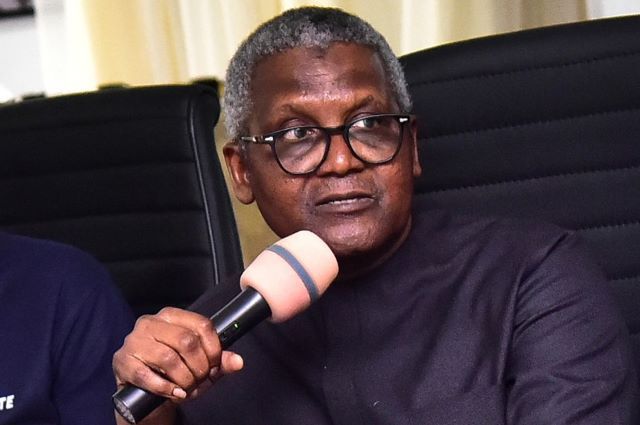
Africa must strengthen its financial institutions, expand electricity infrastructure and adopt policies that promote domestic manufacturing to become a global industrial powerhouse, President and Chief Executive of Dangote Industries Limited, Aliko Dangote, has said.
Dangote, who unveiled a $50 billion investment programme for 2026 to 2030, said the continent’s vast natural resources, youthful population and investment opportunities could drive sustainable economic prosperity if supported by long-term financing, reliable power supply and deliberate industrial policies.
The industrialist spoke at the Financial Times Africa Summit in London during a conversation with David Pilling, Africa Editor of the Financial Times, where he identified inadequate financing and infrastructure as major obstacles to Africa’s industrial development.
“I think the number one thing that the continent has to concentrate on doing is having very strong financial institutions, their own financial institutions, and also to have very strong agricultural policy, and also industrial policy,” Dangote said.
He described electricity as the most urgent infrastructure requirement for unlocking the continent’s manufacturing potential, declaring: “For Africa, what we need the most today is actually power.”
According to him, inadequate electricity supply has continued to undermine efforts to process Africa’s mineral resources locally, forcing countries to export raw materials instead of capturing the greater economic value associated with manufacturing and processing.
Dangote cited the mining industry as a major example, noting that unreliable electricity supply frequently prevents companies from establishing processing facilities close to extraction sites.
He said approximately 650 million Africans remain without access to electricity, a situation he described as incompatible with the continent’s industrial ambitions. Resolving the power deficit, he added, would attract investments, promote local mineral processing and create substantial employment opportunities.
The industrialist also highlighted the difficulties African businesses encounter in securing long-term financing for large-scale industrial projects, drawing from the experience of developing the Dangote Petroleum Refinery in Lagos.
He disclosed that the Group had to finance the refinery from its own balance sheet because conventional project financing was extremely difficult to secure for major industrial investments in Africa.
Dangote explained that prolonged financing negotiations could undermine the viability of industrial projects by delaying execution, increasing costs and exposing investors to changing economic conditions.
He further disclosed that the refinery project was executed amid severe currency depreciation and the enormous cost of developing supporting infrastructure.
According to him, the exchange rate moved from approximately ₦136 to the dollar to as high as ₦1,800 during the refinery’s development, while about 90 per cent of the Group’s revenue was denominated in naira.
Dangote said the Group’s proposed $50 billion investment programme between 2026 and 2030 was partly designed to demonstrate the capacity of African businesses to execute large-scale projects and encourage other investors to participate in the continent’s development.
“The legacy we are trying to set up is how do we industrialise our continent?” he said.
He stressed that the ambition extended beyond the growth of one conglomerate to building a wider industrial ecosystem capable of supporting businesses, generating employment and retaining more economic value within Africa.
The industrialist also urged African governments to reconsider their approach to industrial protection, warning that allowing cheap imported products to undermine domestic manufacturing could permanently weaken the continent’s productive capacity.
He argued that emerging African industries required appropriate policy support to compete against established international manufacturers, particularly where imported products were sold at prices that discouraged investment in local factories.
Dangote, however, distinguished industrial protection from restrictions on trade between African countries, advocating a regional approach that would strengthen manufacturing while preserving the objectives of the African Continental Free Trade Area.
He maintained that African economies should trade more freely among themselves while establishing a common framework to protect their industries against unfair external competition.
Questioning why Africa continued to experience widespread poverty despite its extensive agricultural land, mineral resources and youthful population, Dangote argued that the continent’s economic challenges were not principally the result of inadequate resources but insufficient productive investment and industrial capacity.
“Why should we remain poor?” he asked.
He expressed confidence that Africa was entering a period in which governments, entrepreneurs and investors were becoming increasingly determined to develop the continent’s productive capabilities.
The Financial Times Africa Summit brought together policymakers, business leaders, financiers and other influential stakeholders to discuss Africa’s role in shaping the next phase of global development.