


























































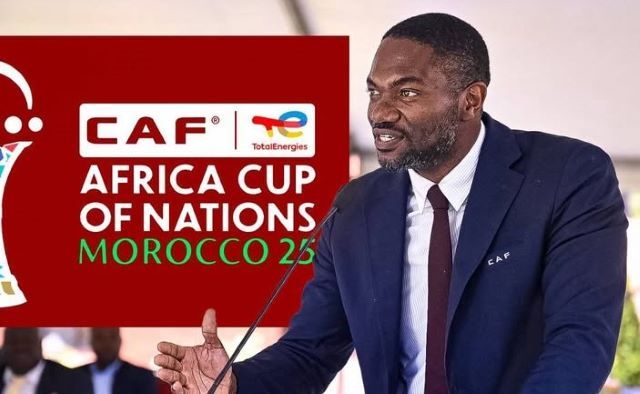
Africa’s football governing body, the Confederation of African Football (CAF), has officially confirmed Nigerian football administrator Samson Adamu as its substantive general secretary, making him the first Nigerian to occupy the position in CAF’s 70-year history.
Adamu, son of former FIFA Executive Committee member Amosu Adamu, previously served in the role in an acting capacity.
He was appointed Acting General Secretary on Sunday, March 29, 2026, following the resignation of Swiss-Congolese administrator Véron Mosengo-Omba.
Before his elevation, Adamu held several key positions within CAF, including Director of Competitions and Director of Tournaments and Events.
Meanwhile, the Nigeria Football Federation (NFF) has congratulated Adamu on his appointment, calling it a significant milestone for Nigerian football.
“This is, indeed, excellent news. I am so happy for Samson Adamu on his confirmation, and I know he is going to make Nigeria and Africa proud. He is a highly knowledgeable individual who has never stopped improving himself, and he is well-rounded in the business of football administration,” Acting General Secretary Dr. Emmanuel Ikpeme told thenff.com.
“The NFF is delighted and very pleased with this appointment, and we will give him all the necessary support as a member of the Association under CAF. We wish him tremendous success in the job.”
Meanwhile, CAF has reversed its earlier decision to stage the Africa Cup of Nations AFCON every four years, restoring the competition to its traditional two-year cycle.
The decision was unanimously reached at a CAF Executive Committee meeting held on Thursday.
CAF President Patrice Motsepe had recently indicated at the continent’s strategy conference in Cabo Verde that the Executive Committee would reconsider its previous decision to move AFCON to a four-year cycle.
The initial proposal was part of CAF’s broader plan to introduce a new Africa Nations League, which was expected to replace AFCON as the continent’s biennial national team competition.
However, CAF acknowledged that developing the proposed Africa Nations League into a globally competitive and financially self-sustaining tournament would take several years.
Explaining the decision, Motsepe said the return to a two-year AFCON cycle was driven by the need to protect the interests of African football, CAF’s 54 member associations, and African players competing for clubs outside the continent.
He added that CAF was concerned about the lengthy period required for the proposed Africa Nations League to deliver the financial and football development benefits needed to strengthen African football.
“The decision by the CAF EXCO that the AFCON should take place every two years was based on advancing, protecting, and promoting the interest of African football and CAF’s 54 member associations, as well as the interest of African players employed by football clubs outside Africa,” Motsepe was quoted by CAFonline.
“We were also concerned by the several years required before the proposed new Africa Nations League Pan-African competition (which was supposed to be identical to the current AFCON and take place every two years) could make the substantial financial and football development contributions for African Football and CAF competitions to be globally competitive and self-supporting.
“The next AFCON will take place in 2027 in Kenya, Tanzania, and Uganda, and I am confident that it will be very successful. The subsequent AFCONs thereafter will take place in 2028, 2031, and 2033.
“The forthcoming FIFA World Cup will take place in 2030, and in accordance with the FIFA tradition, the final tournament of the AFCON and other Confederations National Teams competitions may not take place during the year of the FIFA World Cup.
“The AFCON competition is also about celebrating African football and Africa’s rich and diverse cultures, customs, and traditions and bringing people together from Africa’s 54 countries, the African diaspora, and throughout the world.
“The CAF EXCO decision is in the best interest of African Football and CAF’s 54 Member Associations and will also contribute significantly to the development and growth of football in Africa.”
Packaged by Lanre Olabisi