





















































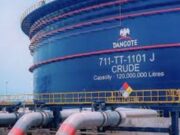









Nigeria’s domestic oil refining sector recorded an unprecedented expansion in the second quarter of 2026, surging by 43.94 percent year-on-year, as the massive Dangote Petroleum Refinery ramped up its output and fundamentally altered the nation’s energy economics.
The latest figure was contained in the Q2 2026 Gross Domestic Product report released by the National Bureau of Statistics (NBS) on Monday.
The report, which provides rebased quarterly GDP estimates, covers all four quarters of 2025 and the first two quarters of 2026.
The strong refining performance comes as the Dangote refinery continues to ramp up operations following the completion of maintenance and expansion work in February.
The upgrade increased the refinery’s crude oil distillation capacity from 650,000 barrels per day to 700,000 barrels per day, further strengthening its role in Nigeria’s downstream petroleum sector.
The higher capacity has also coincided with a sharp increase in Nigeria’s refined petroleum product exports to international markets across Europe, Africa, and Asia.
NBS data showed that refining growth accelerated from 37.46 percent in Q1 2025 to 43.94 percent in Q2 2026, significantly exceeding the 19.42 percent and 12.33 percent recorded in the third and fourth quarters of 2024, respectively, under the rebased series.
The sector recorded full-year growth of 14.08 percent in 2024.
In nominal terms, the value of oil refining activity also increased significantly, rising from about N2.46 billion in Q1 2026 to N5.36 billion in Q2.
The Q2 figure represented a 90.85 per cent year-on-year increase, compared with 57.06 per cent recorded in the first quarter.
The latest performance marks a notable improvement from the earlier period, with the previous GDP series recording refining growth of 35.81 per cent for the full year 2023 and 16.67 per cent in 2024.
The Dangote Petroleum Refinery has emerged as the dominant force behind the expansion of Nigeria’s refining capacity, with its increased crude processing capacity driving higher production.
Data from the Nigerian Upstream Petroleum Regulatory Commission showed that domestic crude oil and condensate supply to local refineries reached 97.4 percent in Q2 2026, with 53.7 million barrels supplied between April and June.
Dangote accounted for the bulk of the crude supplied to domestic refiners during the period.
The refinery required 63 million barrels during the quarter, while producers offered 68.1 million barrels. It eventually accepted 52.6 million barrels, representing about 78 percent of the volume offered to it.
This was a significant improvement from the first quarter, when only 28.5 million barrels were delivered to domestic refineries despite 61.9 million barrels being allocated and 68.7 million barrels offered by producers.
The increased availability of crude, combined with Dangote’s higher processing capacity, has helped raise refined petroleum output and reshape Nigeria’s petroleum trade.
The stronger refining performance came amid broader growth in Nigeria’s oil sector.
Crude oil production averaged 1.72 million barrels per day in Q2 2026, up from 1.68 million barrels per day in the corresponding quarter of 2025 and 1.55 million barrels per day in Q1 2026.
The oil sector grew by 7.31 per cent year-on-year during the quarter, compared with 20.46 per cent in Q2 2025 and 2.57 per cent in Q1 2026.
On a quarter-on-quarter basis, the sector expanded by 10.91 percent.
Its contribution to real GDP also increased to 4.16 per cent, from 4.05 per cent in Q2 2025 and 3.92 per cent in Q1 2026.
Meanwhile, Nigeria’s overall economy grew by 4.43 per cent in real terms year-on-year in Q2 2026, compared with 4.23 per cent in the same quarter of 2025.
The non-oil sector expanded by 4.31 per cent, up from 3.64 per cent in Q2 2025 and 3.94 per cent in Q1 2026, accounting for 95.84 per cent of real GDP during the quarter.
Nigeria’s expanding refining capacity is increasingly translating into higher petroleum product exports, rather than merely replacing imported refined products.
According to the US Energy Information Administration, Nigeria’s seaborne petroleum product exports averaged 350,000 barrels per day in Q2 2026, compared with an annual average of 46,000 barrels per day in 2023.
Total seaborne petroleum product shipments averaged 561,000 barrels per day during the quarter.
Europe received about 130,000 barrels per day, up from 40,000 barrels per day in 2025 and 15,000 barrels per day in 2023.
Other African markets received nearly 120,000 barrels per day, while about 110,000 barrels per day were shipped to Asia and Oceania.
Packaged by Lanre Olabisi