




























































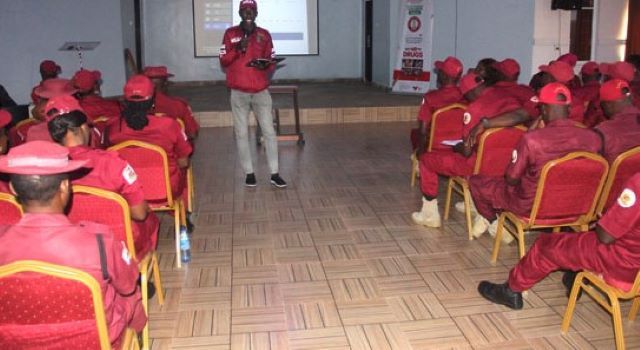
The Oyo State Security Network Agency and Amotekun Corps (OYSSNA) have forged a stronger partnership with the National Drug Law Enforcement Agency (NDLEA) to tackle drug abuse and its associated security challenges across communities in the state.
The collaboration was strengthened during a one-day sensitisation programme organised by the NDLEA for Amotekun operatives, focusing on drug abuse prevention, identification of substance-related risks, healthy coping strategies, responsible conduct, and community-based approaches to promoting drug-free communities.
In his welcome address, the Oyo State Commandant, Col. Olayinka Olayanju (rtd.), represented by the Director of Finance and Accounts, Mrs. Adigun Yetunde, appreciated the NDLEA for the initiative and collaboration.
The Commandant stressed the importance of continuous training and capacity building for Amotekun personnel, particularly in areas that directly affect community safety.
He noted that a better understanding of substance abuse would enable officers to recognise emerging risks, respond appropriately, and contribute more effectively to drug abuse prevention efforts within their areas of operation.
Olayanju further urged the personnel to apply the knowledge gained from the sensitisation programme in their daily duties, particularly through responsible observation, information gathering, and collaboration with relevant agencies.
He said a professional and community-oriented approach would strengthen public confidence and enhance collective efforts to build safer and drug-free communities.
Also speaking, the Staff Officer, Drug Integrity Test, NDLEA Oyo State Command, Superintendent of Narcotics O. A. Achichi, thanked the management of Amotekun for supporting the programme.
Achichi emphasised that the fight against drug abuse requires a collective effort involving security agencies, families, schools, community leaders and other stakeholders.
He said Amotekun’s close relationship with communities places its personnel in a strategic position to identify emerging drug-related concerns and provide relevant information to appropriate authorities.
He urged the operatives to maintain professionalism when dealing with suspected drug-related cases, stressing that suspicion should not be treated as proof.
According to him, personnel should observe, verify, and properly document relevant information before referring cases requiring specialised drug law enforcement attention to the NDLEA or other competent agencies.
During the technical session, the NDLEA Staff Officer, Prevention and Sensitisation, Assistant Superintendent of Narcotics Peter Akinbode, explained that drug abuse could negatively affect individuals, families, youths, and community security.
He identified peer influence, curiosity, stress, trauma, unemployment, social pressure, emotional pain and easy access to drugs among factors that could encourage substance use.
Akinbode urged Amotekun personnel to avoid judging or labelling suspected drug users, stressing the importance of observing, documenting, verifying information and referring drug-related cases to competent agencies.
He also introduced the S.A.F.E.R. response model—See, Assess, Facilitate Safety, Escalate Appropriately, Record and Refer—as a guide for professional response to drug-related situations.
Packaged by Temitayo Afolabi