






























































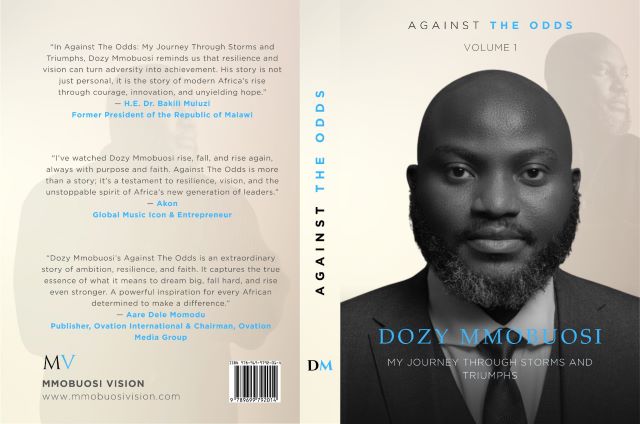
Dozy Mmobuosi’s Against the Odds sits within the growing corpus of African entrepreneurial memoirs, yet it distinguishes itself through an unusual blend of candour, strategic thinking, cultural memory, and developmental vision.
The work functions simultaneously as a personal narrative, a philosophy of leadership, a study in enterprise formation, and an articulation of Africa’s future within the global innovation economy. In its ambition and intellectual breadth, the memoir reflects not merely the life of a Nigerian tech visionary, but the anxieties and aspirations of a continent redefining its place in the 21st century.
- Genesis of a Vision: Origins in Lagos and the Psychology of Becoming
The memoir opens in the restless labyrinth of Lagos—a city whose contradictions, pressures, and possibilities moulded Mmobuosi’s worldview. His account of early life does more than sketch biography; it situates the reader within the socio-economic contingencies that shape many African innovators.
In these chapters, we encounter not a titan of enterprise, but a young Nigerian negotiating uncertainty, scarcity, and the layered complexities of family, education, and survival. This grounding performs an important narrative function. By humanizing the protagonist, the text resists the sanitized triumphalism often found in corporate autobiographies. Instead, Mmobuosi’s formative experiences become a sociological lens through which readers can examine how ambition is forged within liminal spaces of instability.
- The Architecture of Enterprise: Risk, Curiosity, and Multi-Sectoral Innovation
The second movement of the memoir traces the evolution of Mmobuosi’s entrepreneurial consciousness. Here, the writing shifts from personal recollection to strategic analysis. Readers witness the emergence of a mind perpetually drawn to uncharted territory—fintech, agri-tech, telecoms, artificial intelligence, healthcare systems, consumer goods, and other sectors that define modern economic growth.
What is particularly instructive is the consistency of a pattern: curiosity → opportunity recognition → calculated risk → structural innovation.
Mmobuosi’s reflections on these leaps reveal the emotional and operational toll of building at scale in volatile business ecosystems. In doing so, the memoir provides:
Insight into market intuition in frontier economies, a psychological map of entrepreneurial resilience, a nuanced depiction of sacrifice and self-doubt, and a practitioner’s view of business model adaptation in emerging markets.
This section positions the book as a valuable pedagogical tool for African entrepreneurs, business schools, incubators, and policy institutions.
III. Confronting Crisis: Scrutiny, Reputation, and the Politics of Innovation
Perhaps the most compelling dimension of Against the Odds is its treatment of controversy. Unlike many public figures who retreat into euphemism or abstraction when confronting adversity, Mmobuosi adopts a reflective, almost meditative tone. He recounts episodes of institutional pressure, public scepticism, and personal trial with a blend of vulnerability and analytical distance.
These chapters illuminate the fragile interface between innovation and public perception in societies where regulatory frameworks are evolving, and where entrepreneurial ambition is sometimes misread as overreach.
By engaging openly with moments of crisis, Mmobuosi enriches the memoir’s emotional and intellectual depth. The reader is invited to consider how reputations are constructed, contested, and reconstituted—an inquiry that resonates widely within African socio-political economies.
- A Manifesto for Africa: Reimagining the Continent’s Trajectory
Beyond autobiography, Against the Odds emerges as a visionary text. Mmobuosi articulates a future in which Africa is not merely integrated into global systems but becomes a driver of technological and economic transformation. His arguments centre on: youthful demographic advantage, continental natural resources, intellectual capital, the urgency of supply-chain sovereignty, the role of homegrown technology, and investment in human capital.
This is not rhetoric. It is a strategic proposition that challenges reductive narratives about African dependency. In this regard, Mmobuosi contributes to a tradition of African thought leadership that spans Kwame Nkrumah, Chinua Achebe, Ali Mazrui, and contemporary development theorists.
- Narrative Craft: Clarity, Accessibility, and Emotional Precision
Stylistically, Against the Odds is marked by clarity and pace. The language is accessible without being simplistic, and the narrative transitions—between private memory, business analysis, and visionary discourse—are executed with discipline. Though the memoir is steeped in entrepreneurial detail, its emotional honesty ensures the story remains relatable to a broad audience.
The writing bears the texture of lived experience rather than the polished detachment typical of ghostwritten corporate memoirs. This strengthens its authenticity and broadens its appeal.
- Why Against the Odds is a Significant Work
The book arrives at a pivotal moment in Africa’s developmental arc. As global markets turn their attention to the continent’s innovation potential, authentic narratives from African builders become essential to understanding the dynamics of growth from the inside out. Mmobuosi offers: a case study in resilience, a map of entrepreneurial navigation in frontier markets, a reflection on leadership, accountability, and legacy, and a call to action for African ambition.
For scholars, policymakers, investors, media professionals, and leaders—especially those like OJ, whose work intersects with development, governance, and narrative framing—the memoir provides a rare, unfiltered view into the human struggles and institutional negotiations behind Africa’s emergent innovation class.
Conclusion: A Timely, Necessary Contribution
Against the Odds transcends the conventions of entrepreneurial memoir. It is a textured, introspective, and intellectually generous work that speaks to the volatility and promise of African enterprise. By weaving personal vulnerability with professional insight and continental vision, Dozy Mmobuosi delivers a narrative that is both instructive and deeply human.
Ultimately, the book affirms one of the most enduring truths about leadership: that resilience is not merely the ability to withstand pressure, but the courage to create possibility where none seems to exist.
In that sense, Against the Odds is not only a record of one man’s journey—it is a testament to the collective aspirations of a rising continent.