









































![L-R: Managing Director, BGL Securities Limited, Arnold A. Dublin-Green; Assistant Vice President, Financial Derivatives Limited, Dr. Ifeoma Nwokolo; CEO, Centre for the Promotion of Private Enterprise [CPPE], Muda Yusuf (speaker); Chairman of the Occasion, Chief Paul Usoro; Dean, Lagos Business School, Information Systems, Prof. Olayinka David-West; Managing Director/CEO, Financial Derivatives Company, Bismarck Rewane; Group Chief Branding & Communications Officer, Dangote Industries Limited, Anthony Chiejina at Dangote Petroleum Refinery & Petrochemicals IPO Roadshow tagged “Back to where it all began” in Port Harcourt. Rivers State on Monday, October 12, 2026…](https://pmparrotng.com/wp-content/uploads/2026/10/Dangote-imagee-180x135.jpg "As Dangote Refinery’s IPO Nears Close, Small Investors Take Center Stage")






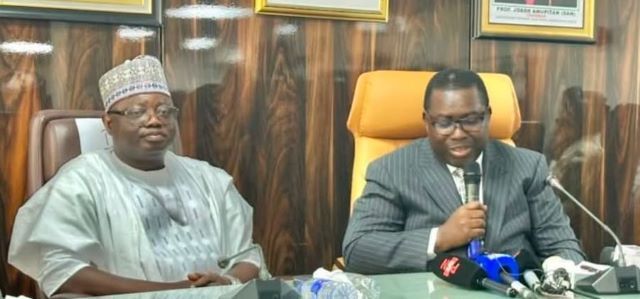
The Director-General of the National Orientation Agency (NOA), Mallam Lanre Issa-Onilu, has reaffirmed the agency’s commitment to strengthening collaboration with the Independent National Electoral Commission (INEC) to deepen voter and civic education, promote patriotism, and increase citizens’ participation in Nigeria’s democratic process ahead of the 2027 General Election.
Speaking during a courtesy visit to the chairman of INEC, Professor Josh Amupitan, SAN, at the commission’s headquarters in Abuja on Wednesday, Issa-Onilu said democracy thrives only when citizens are adequately informed and actively participate in the electoral process.
The Attorney General thanked the INEC Chairman and members of the Commission for the warm reception and commended the Commission for its efforts in strengthening Nigeria’s electoral system.
According to him, “Democracy is sustained when the people are well-informed.” “If there is anything that we cannot play with, it is the issue of deciding who our leaders should be. It is the right of the citizens to do that, and we all have a responsibility to protect and strengthen that process.”
Issa-Onilu said the 2023 general election exposed significant gaps in civic and voter education, especially among first-time voters, leading to widespread misconceptions about electoral processes.
“The last election in 2023 saw many first-time participants. We saw huge gaps in knowledge and a lot of productive time committed to issues that should never have been debated because there was so much misinformation. That was very profound and very dangerous for all of us as a country,” he said.
He stressed that neither NOA nor INEC could effectively address the challenge alone, noting that sustained collaboration between both institutions remained critical.
“We knew there was no way we would be able to do that job alone without the support of INEC because you have the core responsibility to deliver democracy in this country,” he stated.
Highlighting the agency’s nationwide reach, the director-general said NOA possesses an extensive grassroots communication structure, with offices in all states, local government areas, area offices, zonal directorates, and community networks capable of delivering civic education to every part of the country.
“All that we do is to communicate government policies, programs, and projects and generate feedback. We have the infrastructure to reach the grassroots across the country.”
Issa-Onilu explained that beyond communicating government policies, NOA’s second constitutional mandate is to promote nationalism and patriotism.
“We promote nationalism, patriotism, love for the country, and good character. Sometimes government can build roads, bridges, and schools, but when citizens are psychologically disconnected from their country, they destroy public property because they do not feel connected. You cannot legislate patriotism or enforce it. You motivate it by building trust.”
He cited the recent reception of stranded Nigerians repatriated from abroad as one of the practical demonstrations of government showing care for its citizens, saying such actions help rebuild citizens’ confidence in their country.
The NOA Director-General made three major requests to INEC, beginning with institutionalising continuous voter education.
“Education is not a one-off activity. It has to be continuous. It should not begin only a few months before an election. It ought to be an ongoing process.”
He also called for stronger collaboration in civic and voter education, saying both organisations share similar constitutional responsibilities in that matter.
“We both have civic education and voter education in our mandates. We need to increase the number of people who come out to vote. We need to let Nigerians understand not only the voting process but also what happens after elections, including the electoral dispute resolution process.”
Issa-Onilu further proposed closer collaboration between INEC’s Voter Education Department and NOA’s Department of Civic Values and Democracy Education to institutionalise joint programmes.
Earlier, the chairman of INEC described the visit as “a vital meeting of minds” between two institutions constitutionally saddled with educating Nigerians on democratic culture.
“It is a distinct pleasure to welcome you, DG of the National Orientation Agency, and your dynamic team. This is not a routine visit; it is a vital meeting of minds and a reunion of two institutions constitutionally saddled with the responsibility of educating Nigerians on democratic culture.”
Amupitan emphasised that INEC alone could not build a robust democracy, regardless of advances in electoral technology.
“We can purchase the finest Bimodal Voter Accreditation System (BVAS) machines, optimise the INEC Result Viewing Portal (IReV) to international standards, and improve logistics, but all these technological and administrative triumphs mean nothing if citizens remain detached, cynical, or uneducated about the power of their votes.”
The INEC Chairman described NOA as “Nigeria’s premier organisation for civic orientation,” adding that while INEC manages elections, NOA remains “the custodian of the values that make the players and the spectators respect the rules.”
Citing relevant provisions of the National Orientation Agency Act, he said the partnership between both institutions was “not a secondary option; it is an absolute necessity.”
Amupitan warned that voter apathy, cynicism, and misinformation remain major threats to Nigeria’s electoral process.
“We are battling a silent, dangerous enemy in our electoral ecosystem: voter apathy and deep-seated cynicism. We also see a sophisticated, orchestrated wave of fake news and disinformation designed to make ordinary Nigerians believe their votes will not count.”
He called for a decentralised grassroots voter education campaign that would explain not only when Nigerians should vote but also why their votes matter and how modern electoral technology safeguards the integrity of the process.
“We must teach them why their vote matters and how our new legal and technological safeguards protect their choices.”
The INEC chairman noted that although recent elections in the Federal Capital Territory and the Ekiti State governorship poll demonstrated improvements in election administration, they also exposed persistent voter apathy and inadequate public understanding of evolving electoral procedures.
“These elections revealed a persistent, deeply concerning undercurrent of voter apathy alongside widespread confusion among urban newcomers regarding polling unit splits and registration transfers. While our technology is moving forward, civic familiarity with the evolving system is lagging.”
Amupitan urged both institutions to immediately begin preparations for the 2027 general election through sustained voter education and joint campaigns against vote-buying and misinformation.
“As we look toward the 2027 timelines, we must begin the heavy lifting right now. Let us build joint campaigns against the toxic menace of vote-buying and misinformation, and let us work together so that NOA field officers become trusted ambassadors of truth in their communities.”
He assured the NOA of INEC’s full support.
“Our doors are wide open. We are ready to pool our resources, share our data, and give your teams all the institutional support required to make this collaboration a resounding success.”
Both organisations expressed confidence that closer institutional collaboration would strengthen civic consciousness, improve voter participation, and enhance the credibility of Nigeria’s democratic process ahead of the 2027 General Election.
The NOA Director-General was accompanied by members of the agency’s management team, including the Director, Special Duties/State Operations, Mr. David Akoji; the Director, Civic Values and Democracy Education Department, Dr. Olukemi Afolayan; the Director, Communication and Media Department, Mallam Bala Musa; the Director, Planning, Research, and Strategy Department, Mr. John Asade Bala; the Director, Community Outreach Development Department, Mrs. Adeline Waye; and the Special Assistant on Intergovernmental Affairs to the DG NOA, Mrs. Sherifat Adegbesan.
Also in attendance on the INEC side were the National Commissioners and members of the Commission’s management, including Mrs. May Agbamuche-Mbu, Chair, Legal Services, Clearance, and Complaints Committee; Prof. Rhoda Gumus, Chair, Health and Welfare Committee; Rear Admiral Jemila Malafa (Rtd.), mni, OFR, National Commissioner; Prof. Sani M. Adam, SAN, Chair, Estate, Works, and Transport Committee; Prof. Abdullahi Abdu-Zuru, Chair, Outreach and Partnership Committee; Prof. Kunle Ajayi, Chair, Board of the Electoral Institute; Mr. Sam Olumekun, mni, Chair, Appointments, Promotions, and Disciplinary Committee; and Dr. Mrs. Rose Oriaran-Anthony, fnipr, Secretary to the Commission.
Packaged by Lanre Olabisi