
































President Bola Ahmed Tinubu‘s visit to Ibadan on Saturday, November 21, 2026, was much more than another presidential outing or an ordinary political rally.
It was a carefully watched political engagement that brought together presidential ambition, party mobilisation, traditional institutions, regional calculations and the unfolding contest for political influence in Oyo State ahead of the 2027 general elections.
From the moment preparations began, the ancient city was transformed into a theatre of political activities. Party faithful, political support groups, prominent APC figures, traditional rulers and residents became part of the atmosphere surrounding the President’s visit.
At the centre of the spectacle was Mapo Hall, one of Ibadan’s most recognisable historical landmarks and a venue whose political significance has endured through different generations.
But beneath the colourful displays, enthusiastic supporters, political speeches and presidential entourage lay a number of important questions: What exactly did Tinubu hope to achieve in Ibadan? What message did his visit send to Governor Seyi Makinde and the opposition? What does his public endorsement of Senator Sharafadeen Alli mean for the Oyo APC? And, perhaps more importantly, how much political significance should be attached to the razzmatazz that accompanied the visit?
Tinubu takes the battle to Makinde’s political territory
One of the most significant dimensions of the visit was its political location.
Oyo State is governed by Governor Seyi Makinde, whose political differences with the APC-led Federal Government have become increasingly visible. Makinde has also emerged as a prominent opposition figure ahead of the 2027 presidential election.
By taking his presidential campaign to Ibadan, Tinubu brought the APC’s re-election message into a state where the opposition has an incumbent governor and an established political structure.
The visit therefore represented an opportunity for the ruling party to demonstrate its presence, activate its grassroots machinery and communicate directly with voters in a politically important state.
It was also a reminder that the political contest in the South-West would not be determined solely by the activities of the ruling party or the influence of individual governors.
Mapo Hall: More than a rally venue
The choice of Mapo Hall was significant in its own right.
Situated in the heart of Ibadan, the historic venue has witnessed important political gatherings and public events over the years.
Its selection provided the APC with an opportunity to connect its contemporary political campaign with a location that occupies an important place in Ibadan’s political and cultural history.
The gathering also offered an opportunity for the party to showcase its organisational structures and mobilisation capacity in Oyo State.
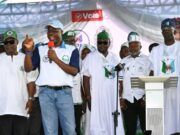
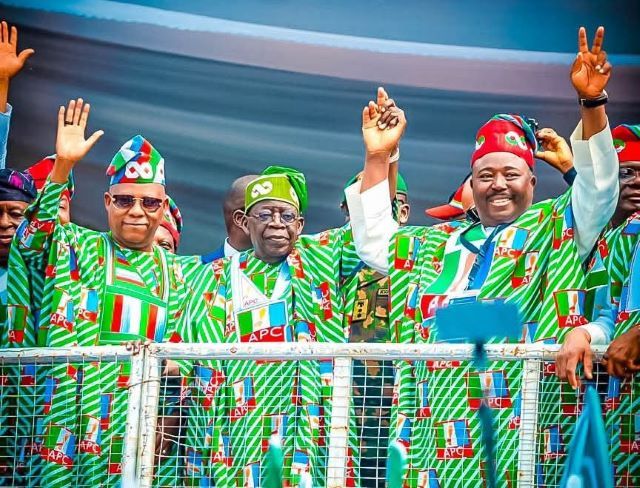
Thousands of supporters converged on Mapo Hill ahead of the President’s arrival, creating a lively political atmosphere.
The traditional institution takes centre stage
Another important feature of the presidential visit was the engagement with traditional rulers.
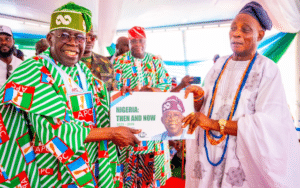
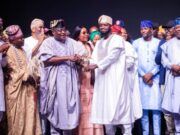
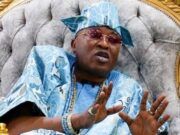
Tinubu met prominent monarchs, including the Olubadan of Ibadanland, Oba Rashidi Adewolu Ladoja, and the Soun of Ogbomoso, Oba Ghandi Afolabi Olaoye.
The engagement placed traditional institutions at the centre of the presidential visit, particularly given the historical influence of monarchs in community relations, cultural diplomacy and public engagement.
For Tinubu, the opportunity to interact with traditional rulers offered a platform for demonstrating respect for established institutions and maintaining relationships with influential stakeholders across the South-West.
However, the meeting should not automatically be interpreted as a political endorsement by the monarchs. Traditional rulers occupy positions that require them to engage governments and political actors across party lines.
The Sharafadeen Alli factor and Oyo APC’s political calculations
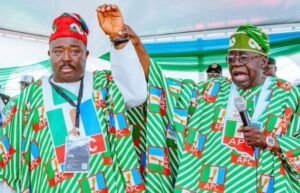
Perhaps one of the most politically consequential moments of the rally was Tinubu’s public endorsement of Senator Sharafadeen Alli, the APC’s governorship candidate in Oyo State.
The President raised Alli’s hand before the cheering crowd, effectively using the national campaign platform to publicly demonstrate support for the party’s candidate.
He also endorsed Senator Solomon Olamilekan Adeola, popularly known as Yayi, in Ogun State, and Lagos Deputy Governor Obafemi Hamzat, the APC’s governorship candidate in Lagos.
For Alli, the endorsement was an important moment in his campaign, providing him with an opportunity to identify his ambition with the political authority of the party’s national leadership.
However, the endorsement also brings into focus the internal challenges that have confronted the Oyo APC.
The party has experienced disagreements surrounding its governorship selection process, including complaints associated with the emergence of its candidate.
Tinubu’s public gesture therefore went beyond campaign entertainment. It was also a demonstration of the national leadership’s position on the party’s candidate as the election approaches.
The Seyi Makinde question and the APM dimension
It would be difficult to discuss the political implications of Tinubu’s Ibadan visit without examining the relationship between the President and Governor Seyi Makinde.
The Oyo Governor has increasingly positioned himself outside the APC’s political orbit and is seeking the presidency on the platform of the Allied Peoples Movement (APM).
At the rally, Tinubu took a swipe at the opposition political platform, referring to it as a ‘palẹmọ’ group, a Yoruba expression suggesting a political organisation without a meaningful destination.
Although the President did not need to mention Makinde by name for the political implication to become apparent, the remarks highlighted the emerging rivalry between the two political figures.
The exchange also demonstrated that the 2027 contest in Oyo State would involve more than the struggle for control of the state’s governorship. It would be connected to the wider national contest for political power.
City Boy Movement and the politics of political entertainment
The razzmatazz surrounding the visit was not restricted to the main rally.
Political support groups, particularly the City Boy Movement, organised activities aimed at generating excitement and mobilising young people ahead of the President’s arrival.
Among the activities were youth engagement programmes, a walk, a concert and food distribution initiatives.
These activities reflected the growing importance of political support groups in modern electioneering, where campaigns increasingly extend beyond conventional party meetings to include entertainment, social engagement and grassroots outreach.
The involvement of young people was particularly significant because political parties are increasingly seeking ways to connect with younger voters, who constitute an important segment of the electorate.
Nevertheless, the real test of such mobilisation efforts will be whether the enthusiasm generated during campaign events translates into sustained political participation and support at the ballot box.
Security vehicles and the development question
Beyond the partisan activities, the visit also provided an opportunity to draw attention to security and regional development.
The President was scheduled to inaugurate security vehicles procured by the South-West Development Commission for the region.
The initiative placed security among the important issues associated with the visit, particularly against the background of persistent concerns about insecurity across different parts of the country.
The deployment of such vehicles, however, is only one aspect of the broader security challenge.
Their eventual effectiveness will depend on proper deployment, maintenance, intelligence gathering, coordination among security agencies and the capacity to respond promptly to threats.
For residents of Oyo State and the wider South-West, the more important question is how the initiative will improve everyday security.
The Leyland factory promise: Beyond political speeches
One of the potentially far-reaching announcements associated with Tinubu’s visit was the proposed revival of the defunct Leyland vehicle assembly plant in Ibadan.
The President disclosed that his administration had reached an agreement with Chinese automobile manufacturer Yutong to revive the facility for vehicle assembly.
For Ibadan, a city with a history of industrial and commercial activities, the announcement carries considerable economic significance.
The revival of the plant could create employment opportunities, stimulate industrial activities, encourage technology transfer and strengthen the city’s position as an important commercial centre in the South-West.
However, the announcement must eventually be measured against implementation.
The people of Oyo State will be interested in knowing when the factory will commence operations, the number of jobs it will create, the investment involved and the extent to which local workers and businesses will benefit.
The proposed revival could become one of the most tangible legacies of the visit if the agreement translates into an operational industrial facility.
The Bayelsa tragedy and the politics of a low-key rally
Interestingly, the elaborate preparations for Tinubu’s visit were tempered by a national tragedy.
Following a fatal boat accident in Bayelsa State, the President directed that the Ibadan rally should be observed without much fanfare in honour of those who lost their lives.
A minute’s silence was observed during the event.
The decision introduced a sombre dimension to what would ordinarily have been a colourful political gathering featuring entertainment, music, elaborate decorations and enthusiastic displays by party supporters.
It also presented a contrast between the political excitement surrounding the campaign and the need for sensitivity to a national tragedy.
The development demonstrated that presidential campaign activities could be adjusted to reflect events of national importance.
When political razzmatazz meets the reality of political disagreements
While the rally attracted a large crowd, reports of disorder and political clashes around the venue raised concerns about the conduct of political activities.
The International Centre for Investigative Reporting (ICIR) reported clashes, gunfire and disorder around Mapo Hall during the event.
Such incidents raise important questions about political tolerance, security arrangements and the responsibilities of political parties and their supporters.
A political rally should provide an opportunity for citizens to express their political preferences without intimidation or violence.
The 2027 elections will require political actors to demonstrate that competition for power can take place within the boundaries of democratic conduct and respect for opposing views.
The Ibadan political event had in attendance the Vice President, Senator Kashim Shettima; First Lady, Senator Oluremi Tinubu; wife of the Vice President, Nana Shettima; Senate President, Godswill Akpabio; Deputy Senate President, Ibrahim Barau Jibrin; Senate majority leader, Opeyemi Bamidele; governors of Ogun, Osun, Kwara, Imo, Ekiti, and Ondo; Minister of Power, Mr Joseph Tegbe; Chairman, Nigerian Revenue Service(NRS), Dr. Zacch Adedeji; Oyo APC Chairman, Chief Moses Alake; among others dignitaries.
The opposition’s response and the battle over public perception
No major political gathering in an election season is complete without competing interpretations of what transpired.
While APC leaders and supporters presented the rally as evidence of their political mobilisation in Oyo State, the opposition offered a different interpretation of the event.
The campaign organisation associated with Governor Makinde criticised Tinubu over the turnout at the rally, introducing another dimension to the contest over public perception.
This is an important feature of contemporary Nigerian politics: political parties increasingly treat crowd size, attendance, photographs, videos and social media reactions as instruments for communicating political strength.
But crowd estimates and campaign-day enthusiasm are not substitutes for election results.
The ultimate assessment of political support must come through credible electoral processes rather than competing claims made by rival political camps.
The bigger picture: What does Tinubu want from Ibadan?
Ultimately, Tinubu’s visit should be understood within the wider political calculations surrounding the 2027 general elections.
Oyo State occupies an important position in South-West politics, and Ibadan remains a significant political, commercial and demographic centre. The city is generally regarded as the political headquarters of the Yoruba people of the South-West of Nigeria.
For the APC, the visit provided an opportunity to consolidate its structures, promote its candidates, engage traditional institutions and communicate the achievements and promises of the Federal Government.
For Tinubu personally, the occasion offered a platform to take his re-election campaign to his geopolitical zone and remind the electorate of his party’s political presence.
For Senator Alli, the presidential endorsement provided an important campaign moment.
For Governor Makinde and other opposition political actors, the visit presented another opportunity to assess the ruling party’s mobilisation efforts and prepare their own political responses.
The visit also highlighted the importance of traditional institutions, political support groups and regional development initiatives in the evolving electoral landscape.
Beyond the music, crowds and presidential entourage
President Tinubu’s visit to Ibadan was undoubtedly a major political event, but its significance should not be measured exclusively by the size of the crowd, the number of dignitaries in attendance or the excitement generated at Mapo Hall.
The more important issues concern what happens after the presidential entourage has departed.
Will the proposed revival of the Leyland factory become a reality? Will the security vehicles improve the safety of residents across the South-West? Will the APC successfully manage its internal disagreements in Oyo State? Will the President’s endorsement of Senator Sharafadeen Alli translate into a more coordinated campaign structure? And how will the opposition respond to the ruling party’s renewed mobilisation?
These are the questions that deserve attention beyond the political entertainment.
As the countdown to the 2027 general elections continues, Ibadan has once again demonstrated why it remains an important arena in Nigeria’s political calculations.
The music may have stopped, the campaign banners may eventually come down and the presidential convoy may have left town, but the political contest highlighted by the visit is far from over.
For Tinubu, Ibadan was another campaign destination. For the APC, it was an opportunity to demonstrate political strength. For the opposition, it was a moment to reassess the challenge ahead. For the people of Oyo State, however, the most important consideration remains whether the promises and political engagements will translate into tangible improvements in their lives.
Packaged by Olayinka Agboola