































































The Director-General of the National Orientation Agency (NOA), Mallam Lanre Issa-Onilu, has called for a deliberate reorientation of the Nigerian workforce to ensure that the increasing adoption of Artificial Intelligence (AI) is guided by values, ethics, productivity, and national consciousness.
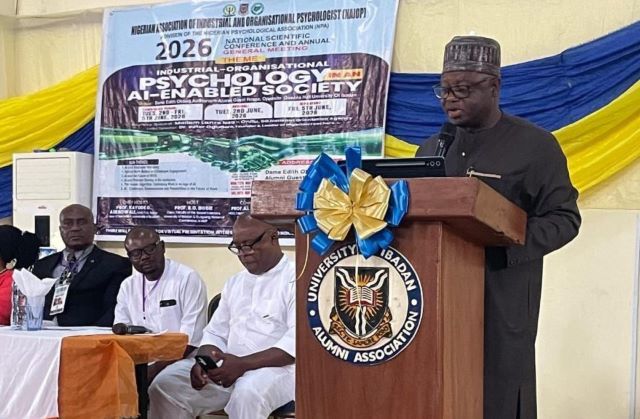
Mallam Issa-Onilu made the call while delivering the keynote address at the 2026 Conference and Annual General Meeting of the Nigerian Association of Industrial and Organizational Psychologists (NAIOP), a division of the Nigerian Psychological Association (NPA), hosted by the Department of Psychology, Faculty of the Social Sciences, University of Ibadan, under the theme “Industrial and Organizational Psychology in an AI-Enabled Society.”
The Director-General, who was accompanied by the Director, Civic Values and Democracy Education, Dr. Olukemi Afolayan, and the Oyo State Director of NOA, Mrs. Ajolayo Akande, spoke on the topic, “Reorienting the Nigerian Workforce in the Age of Artificial Intelligence: Values, Productivity, and National Development.”
According to him, artificial intelligence has already become an integral part of modern life, influencing communication, governance, learning, production, and decision-making, but he cautioned that technology, powerful as it is, cannot replace wisdom, morality, character, and sound national values.
“Artificial intelligence can process information, but it cannot replace wisdom. It can automate tasks, but it cannot define national goals. It can increase speed, but it cannot build character,” he stated.
The NOA boss emphasized that while AI presents enormous opportunities for economic growth, innovation, and improved service delivery, its benefits can only be fully realized when citizens and institutions are guided by integrity, accountability, empathy, discipline, and patriotism.
He noted that Nigeria’s productivity challenge extends beyond technology and is fundamentally a value challenge, stressing that no amount of technological advancement can compensate for weak institutions, lack of accountability, and the erosion of ethical standards.
Mallam Issa-Onilu maintained that the future Nigerian worker must be technologically competent and globally competitive while remaining morally grounded, socially responsible, and nationally conscious.
Highlighting the strategic role of industrial and Organizational Psychology in an AI-driven society, the Director-General urged psychologists and professionals to help organizations build cultures that promote fairness, emotional intelligence, adaptability, trust, and human dignity.
He explained that the National Orientation Agency is repositioning itself to address the realities of a rapidly evolving digital society through innovative and technology-driven initiatives.
The Director-General listed some of the initiatives introduced under his leadership to include the National Values Charter, Citizens’ Feedback Dashboard, NOA Media Hub, Explainer Weekly, and CLHEEAN, an artificial intelligence-powered civic education platform designed to provide citizens with information on government policies and programs while enhancing public enlightenment and civic engagement.
According to him, digital transformation must go hand in hand with behavioral transformation, adding that the agency’s objective is to deepen national consciousness, strengthen trust, and promote responsible citizenship.
He identified five pillars necessary for building a future-ready workforce and achieving sustainable national development as values, skills, productivity, well-being, and national purpose.
“Values must place integrity, discipline, accountability, and respect for human dignity at the center. Skills must equip citizens for the future. Productivity must reward excellence and measurable results, while national purpose must connect the work of institutions to Nigeria’s unity, security, and global competitiveness,” he said.
The NOA helmsman further charged students and young Nigerians not to fear the future but to prepare for it through continuous learning, creativity, adaptability, and character development.
“Artificial intelligence will define the future of work, but values will define the future of Nigeria. Our task is clear: we must raise a workforce that is skilled enough to compete, disciplined enough to deliver, ethical enough to be trusted, patriotic enough to serve, and visionary enough to build the nation of our dreams,” he declared.
Also speaking at the conference, a guest speaker underscored the growing significance of artificial intelligence and emerging technologies in addressing contemporary security challenges. The speaker observed that advances in machine learning, big data analytics, and surveillance technologies have enhanced intelligence gathering, crisis response, and strategic operations globally, while emphasizing the need for context-specific approaches to ensure that technological innovations contribute effectively to national security and development.
The conference brought together scholars, professionals, policy makers, students, and stakeholders from various sectors to deliberate on the intersection of industrial and organizational psychology, technology, and national development in an increasingly AI-driven world.
Packaged by Lanre Olabisi