











































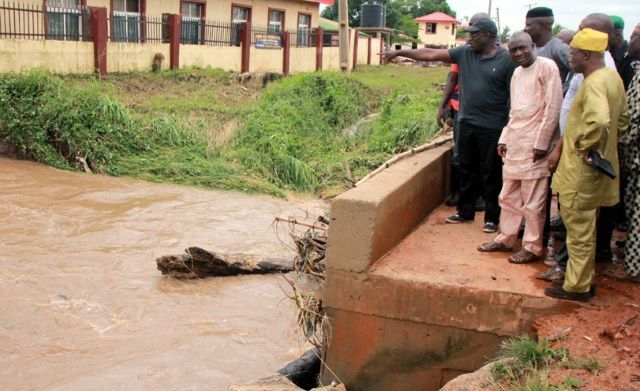
Another rainy season, another tragedy in Ado Ekiti. Reports again of citizens washed away at Ureje, Elemi, Odo-Ado, and Faglo—an elderly woman, an Okada rider, and young Nigerians trying to cross a bridge. The government says no lives lost, divers say they rescued victims, and families say they are still searching.
Whether it is 3 or 4 or none, the real question is not the body count. The question is, why does the Elemi River flood every single year?
We have made a national mistake. We campaign for good leaders, we pray for good leaders, and we blame bad leaders. But development does not come from good leaders. Development comes from strong institutions. With strong institutions, even a bad leader is confined to a system that benefits the masses. With weak institutions, even a good leader becomes helpless.
The Ekiti Flood Is Not a Natural Disaster. It is an institutional failure.
Floods in Ado Ekiti are predictable. NIMET predicts it. The rivers are known—Ureje, Elemi. The causes are known—building on waterways, blocked drains, no dredging before the rainy season, and refuse in canals. If it is predictable and preventable, why does it happen yearly?
Because we have no institutional framework that enforces consequences.
1. Where is the active town planning institution that stops a man from building on a flood plain at Oke-Ila or Nova Road? In 2013, Governor Fayemi said houses without approval on flood plains would be demolished. 13 years later, the same houses are still there, and new ones have joined them.
2. Where is the waste management institution that penalizes dumping refuse in drains? We dredge in January; citizens fill it with waste in March.
3. Where is the emergency management institution with functional early warning? People were still attempting to cross Ureje Bridge while water was over the bridge.
We do not need a good governor who will dredge rivers after floods have killed. We need a system where dredging MUST happen every November, whether the governor likes it or not, and a monitoring and evaluation unit that publishes compliance.
Peer Review: Ibadan Showed Us the Way and the Warning
Ibadan knows flooding more than any city in Nigeria. The August 26, 2011, flood that killed over 100 people forced a rethink.
What did Oyo State do? They did not just look for a good leader. They built an institution—the Ibadan Urban Flood Management Project (IUFMP), a World Bank-assisted framework with a $200 million commitment.
IUFMP did three things Ekiti must copy:
A. Master Plan + Technology: It developed the Ibadan Flood Risk Management Framework and deployed an Early Warning System with wired sensors that alert flood-prone communities 6 hours before a flood, so they can evacuate. It is not about the governor visiting after the flood; it is about the system warning before the flood.
B. Peer Review in Action: IUFMP dredged 45 rivers and streams across 11 LGAs in Ibadan at once and rehabilitated dams and culverts, not as a political project but as an institutional deliverable with World Bank safeguards.
C. The Institutional Lesson of Failure: Even that institution almost collapsed when political interference delayed contractor selection for 8 months. The World Bank cancelled $52 million of the Second Pool of Long-Term Investment (PLTI2) in 2021 because the government could not meet no-objection conditions. Ibadan Ko’ya Coalition raised an alarm. That is the institution checking leader. When institutions are strong, they can even cancel funding to punish a sitting government. That is what we need in Ekiti.
What the Ekiti State Development Plan Says vs. What We Do
Ekiti State has a 30-year development plan. It clearly states flood control, sustainable urbanization, and environmental resilience as pillars. But where is the monitoring and evaluation?
Development without M&E is a press statement. Every flood in Ado Ekiti is a violation of the State Development Plan, but there is no quarterly M&E dashboard that says, “Elemi dredging: Not Done. Ureje desilting: 40% Done. Building approvals on waterways: 15 illegal approvals.
If we had a statutory M&E agency reporting to the House of Assembly, not to the Governor, with powers to publish compliance, the flood would be reduced by 70%.
1. Legislate Institutions, Not Sympathy Visits: Ekiti House of Assembly should pass a Flood Resilience and Urban Planning Enforcement Law that makes annual dredging of Ureje and Elemi mandatory before March, creates 50-meter no-build buffer zones, and criminalizes building without drainage clearance.
2. Create Ekiti Flood Management Agency (EFMA): Like IUFMP, an autonomous agency with a World Bank/AfDB partnership, with a 5-year funding ring-fenced, not subject to yearly budget politics.
3. Institutionalize M&E: Publish Ekiti State Development Plan a compliance report every quarter. Let citizens know which ministry failed.
4. Stop Celebrating Rescue, Start Celebrating Prevention: We should not praise divers for rescuing 5 people at Ureje Bridge. We should query the system that allowed 800 commuters to be trapped at Ureje Bank in the first place.
Nigerians, let us canvass for good institutions, not just good leaders. Good leaders come and go every 4 years. Strong institutions protect us for 50 years. With the right institutions, a bad leader cannot build on a waterway, and a good leader does not need to beg citizens not to dump refuse in drains.
The flood that washed away our brothers and sisters in Ado Ekiti did not happen because the leader is bad. It happened because the institution that should have stopped it does not exist or exists only on paper.
May God comfort the families affected. And may we finally build systems that stop the next flood before it comes.
Sent in by Michael Ale, Coordinator, Global Development Initiative