






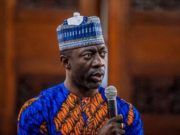





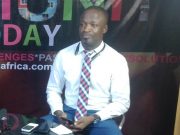







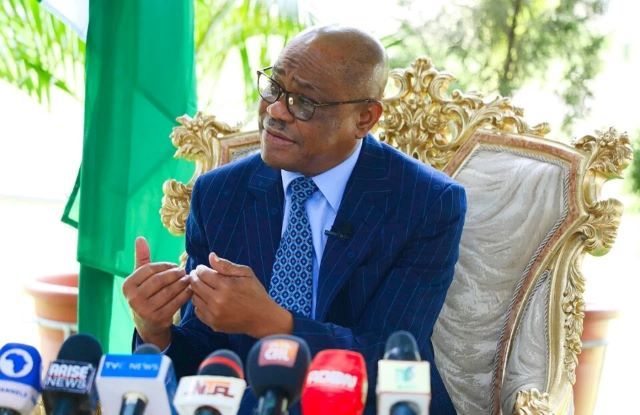
The Nigeria Guild of Editors, the Nigeria Union of Journalists, and the Socio-Economic Rights and Accountability Project have jointly demanded an immediate investigation into a controversial remark by the Minister of the Federal Capital Territory, Nyesom Wike, directed at Channels Television anchor, Seun Okinbaloye.
The call follows Wike’s statement during a media chat in Abuja, in which he allegedly threatened the journalist, saying, “If there was any way to break the screen, I would have shot him,” after Okinbaloye raised concerns that the 2027 general election was beginning to look like a one-party contest.
He was referencing internal challenges within the African Democratic Congress.
The media and rights organisations condemned the comment as a serious threat to press freedom, urging President Bola Tinubu and the Federal Government to take swift action to ensure the safety of journalists and uphold democratic principles.
In a joint statement signed on Monday by NGE President Eze Anaba, General Secretary Onuoha Ukeh, and SERAP Deputy Director Kolawole Oluwadare, the groups expressed deep concern over what they described as a shrinking civic space.
Anaba said, “We are seriously concerned that press freedom is in a ‘downward spiral,’ with increasing intimidation, harassment, threats, and attacks against journalists and media freedom across the country.”
It added, “Public figures, including politicians, are subject to a higher degree of scrutiny and criticism. The threat against Mr Okinbaloye illustrates the escalating threats to the safety and security of journalists and media freedom in the country.”
While defending the broadcaster’s right to speak, Anaba stated, “Like every individual, Okinbaloye is entitled to exercise his right to freedom of expression as a fundamental human right, including the right to seek, receive, and impart information of public interest. His role as a journalist does not diminish or deprive him of this right.”
According to groups, “The right to freedom of expression applies to all kinds of information and ideas, including those that may shock, offend or disturb,” stressing that “any form of effort to coerce the holding or not holding of any opinion is prohibited.”
While acknowledging that Wike had attempted to clarify his remarks, the organisations insisted that “the threat should never have been made in the first place.”
It added, “The objective of those who threaten journalists remains the same: to chill public interest reporting by increasing the risks faced by journalists. Such conduct undermines press freedom and democratic accountability. This must stop.”
They further blamed Nigerian authorities for failing to address growing attacks on journalists, noting that “the continuing failure by the Nigerian authorities to uphold press freedom and to effectively investigate and prosecute the growing cases of threats and attacks against journalists has emboldened those who wish to silence them.
“The failure also reflects wider impunity for human rights violations and disregard for the rule of law in Nigeria,” they added.
The groups warned that impunity for perpetrators contributes to a hostile media environment.
“Impunity for those who threaten, intimidate and harass journalists and media organisations contributes to the hostile environment for these human rights defenders. Nigerian authorities must end impunity for crimes against journalists,” the statement added.
They also raised concerns about broader restrictions on civic space, citing “extrajudicial actions, unlawful detentions, enforced disappearances, malicious prosecutions and the wrongful use of legislation and law enforcement.”
Highlighting the use of legal intimidation, the statement noted, “We are concerned that security agencies and politicians continue to target journalists with lawsuits, generally for libel or criminal defamation, seeking exorbitant damages.
“Known as strategic lawsuits against public participation, the point of the legal action is not necessarily to win the lawsuit but to intimidate or exhaust the resources and morale of the other party.”
The organisations cited data showing that “in August 2024 alone, at least 56 journalists were assaulted or arrested while covering demonstrations across the country,” adding that Nigeria dropped 10 places to 122nd position in the 2025 World Press Freedom Index by Reporters Without Borders.
They reiterated that the 1999 Constitution and international human rights instruments guarantee freedom of expression and press freedom, pointing specifically to Section 39, which affirms “the right to hold opinions and to receive and impart ideas and information without interference,” as well as Section 22, which mandates the media to hold government accountable.
“The Nigerian Constitution and international human rights law protect criticism of public officials and political reporting, including political discourse, commentary on public affairs, and discussion of human rights,” the groups said.
The groups also referenced global standards, noting that “the right to information is a target of the 2030 Agenda for Sustainable Development, and the safety of journalists is a key indicator,” while the United Nations Plan of Action recognises that threats to journalists extend beyond physical attacks to include prosecution, arrest, imprisonment and denial of access.
NGE and SERAP, therefore, called on the President to take concrete steps, including directing law enforcement agencies to investigate threats against Okinbaloye and other journalists and ensuring that those responsible are “cautioned, disciplined or prosecuted.”
They also urged the President to “publicly reiterate support for media freedom,” foster “an independent, diverse and vigorous media,” and mandate the Attorney General of the Federation, Lateef Fagbemi (SAN), to work with relevant agencies to investigate all attacks on journalists since May 29, 2023.
The NUJ, in a statement issued on Monday by its National President, Alhassan Yahya, said the union was “profoundly shocked and outraged” by the minister’s comment.
Yahya described the statement as “reckless and violent,” adding that it “constitutes a direct and unacceptable attempt to intimidate and silence the press, thereby gravely undermining press freedom and the foundational principles of democracy in Nigeria.”
The NUJ said it initially withheld its reaction in the expectation that Wike would retract the statement and apologise.
“The union deliberately delayed issuing this statement, holding a sincere belief that Wike would, upon reflection, demonstrate immediate remorse and promptly withdraw his dangerous comment.
“However, the regrettable absence of any such retraction or apology strongly suggests that the statement was not a momentary lapse but rather a deliberate and intentional act designed to intimidate,” Yayha said.
The union warned that such comments from a senior government official could create fear among journalists and discourage critical reporting.
“This incendiary comment… creates a climate of fear for journalists striving to uphold their professional duties.
“It sends a dangerous message that critical reporting will be met with hostility and threats of violence,” the NUJ president added.
The union called for “an immediate and unreserved apology” from Wike, and urged the Federal Government to take a clear stance.
“We call upon the Federal Government to swiftly and unequivocally condemn this threat, demonstrating its commitment to protecting journalists and safeguarding the independence of the media,” Yahya said.
The union also urged media organisations and civil society groups to stand united in defending press freedom, stressing that “the safety and security of journalists are paramount to a healthy democracy.”
Credit: punchng.com