

























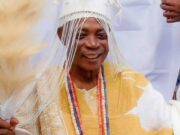





















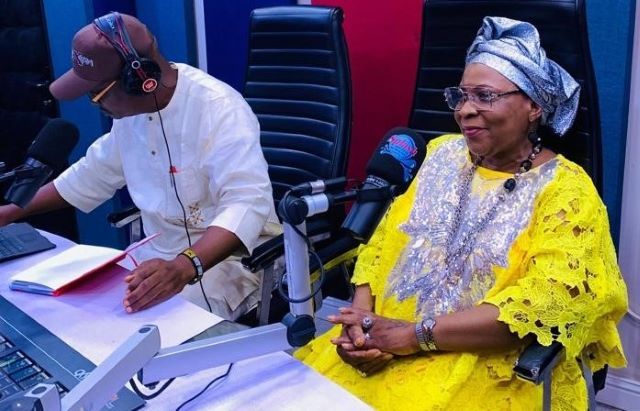
Hon (Chief) Mrs Ramota Funmilayo Okemakinde, former member of the Oyo State House of Assembly, was recently a guest on Parrot Xtra/Ayekooto on Splash 105.5FM, hosted by Olayinka Agboola. During the interview, she discussed party supremacy, leadership, internal democracy, the distinction between APC and PDP, and strategies for APC to reclaim Oyo State in 2027. She also addressed political cross-carpeting, candidate selection, progressive leadership, and the importance of local government autonomy. Excerpts:
How far has the All Progressives Congress (APC) progressed in Oyo State since its inception?
God is the ultimate doer of all things. We are proud of the progress the party has made so far, and we are optimistic that APC will emerge victorious in Oyo State in 2027, as well as at the federal level. Our leader, President Bola Ahmed Tinubu, will also emerge victorious and complete his eight-year tenure, just as others before him did.
Before joining politics, what was your occupation and how did it influence your political journey?
I joined politics at a very young age in the 1980s while I was still in secondary school. Politics came naturally to me because my father was an active politician, and that exposure sparked my interest. When I officially started, I was advised to further my education because I only had my O’Level certificate at the time.
Alongside politics, I was into business. I traded in clothes and shoes and also ventured into food processing. Till today, I remain actively involved in business.
What is your view on politicians without a second or third source of income?
It is not advisable. When a politician has no legitimate means of livelihood, it pushes them into unnecessary and unethical practices. That is why there is now an advocacy for politicians to have a second source of income. Any politician without a stable means of livelihood may eventually turn into a political tout.
Cross-carpeting is common in Nigerian politics. Do you think this practice strengthens or weakens democracy?
Cross-carpeting is not illegal under Nigerian law, especially when there is no peace within a party. If a politician feels constrained or unable to achieve their political ambitions in a particular party, they are free to move to another platform.
How would you compare the quality of representation in the Oyo State House of Assembly between 1999–2003 and now?
It is difficult to generalize, as performance largely depends on individual commitment. However, in 1999, the calibre of lawmakers was closely monitored by the party, and party supremacy was upheld.
Legislators then regularly consulted their constituencies and party leaders before raising motions. Today, that culture of accountability and respect for party leadership has declined. Many current legislators appear more focused on personal interests than collective goals.
What solutions do you propose for challenges in political accountability and commitment among legislators?
The solution lies in selecting credible candidates who genuinely have the interest of the masses at heart. Political parties must properly screen aspirants and choose individuals with clean records who believe in party supremacy and discipline.
Do you believe the candidate selection process in modern politics is flawed?
Yes, it is. In our time, candidate selection was based on integrity, commitment to the party, and family background. I remember when I wanted to contest in 1990 under the SDP–NRC; party leaders contacted my father and advised that my educational qualification might limit my chances.
I was encouraged to return to school and begin my political journey from the grassroots. Although I later contested alongside a candidate with an NCE and won, I was persuaded to step down in his favour.
I later obtained my diploma in 1995 and was encouraged to contest for councillorship, which I won. I later became Vice Chairman and Supervisory Councillor for Works. Six months later, the Chairman resigned to contest another position, and I was appointed Chairman.
After completing our tenure, I intended to contest again, but issues arose. Fortunately, Alhaji Lam Adesina intervened and persuaded me to step aside, acknowledging my contributions and encouraging me to contest for the State House of Assembly instead. I followed his advice and won under the Alliance for Democracy (AD).
Are there still credible progressive leaders in today’s political ecosystem, and where are they most visible?
Yes, there are still progressive-minded leaders whom we respect and submit to. In the Ibarapa zone, for instance, we still have credible progressive leaders.
However, politics has become polluted and bastardised. Today, anyone with money can claim to be a party leader, and respect for hierarchy has diminished. In the past, party leadership followed a clear structure, and wealth alone could not buy influence. Party supremacy is essential if we are to achieve our collective goals. We must return to teamwork and discipline.
What distinguishes the APC from the PDP in ideology and approach?
There is a clear difference. APC is a progressive party, while the PDP is conservative in orientation.
If APC wins the gubernatorial election in Oyo State, what should the people expect?
They should expect excellence in governance. With God’s help, we will deliver because we understand the ideology of progressivism. APC has a clear agenda and plans that align with the needs and aspirations of the people.
What is your view on local government autonomy and its impact on grassroots governance?
Local government autonomy is very important. Local governments must be allowed to function independently so they can effectively support democracy at the grassroots level. With direct autonomy, it becomes easier for them to provide essential social amenities and respond promptly to community needs.